Showing posts with label least favorites. Show all posts

Wednesday, January 28, 2015

Least Favorite Character

This was a really hard week for me.  After all, there are so many characters and, do I pick one that I just dislike because they're poorly written, or do I pick one that I loathe when I read about them?  It was made worse by the fact that I'm pretty sure that I know who Alex is going to pick (and so should you if you've read this blog like.... at all.)


Joffrey is the only character I can remember feeling extreme feelings of hatred for when I read about him.  I mean, the more I read, the more I saw of him, the more I HATED this guy.  Just plain hated him.  I have never wanted a character to be killed off so much in my life as this guy (which, if you've ever read Games of Thrones, you'd realize why this isn't an entirely unreasonable expectation on my part.)

But, like Alex was talking about last week, despite my loathing for Joffrey, it's not because he's a badly written character.  In fact, my disdain for him is because he's so well written.

I have more of a category of characters I dislike, but I don't know what to call them. I do know how they fit together, though... they remind me of one classic character. So I'll just talk about him: Holden Caulfield.

If you hadn't noticed, Cassy and I read a lot of young adult fiction. While there are amazing authors doing incredible things in that genre, it's also a minefield. Teenagers are hard to write. If you are one, you usually don't have the distance and perspective from the experience of teenagerdom to make it relatable to a broader audience, and if you're an adult, it's difficult to honestly remember what it was like to be inside the mind of a teenager.

Holden Caulfield is everything I hate about bad teenage characters. He's that jerk you knew in high school and college who thinks he knows better than everyone and he's really smug about it. He's a distant cynic who hates everything and everyone.

There's a reason that having a character say that their favorite fictional character is Holden Caulfield is a way to demonstrate that your character is a pretentious tool. No offense to anyone who actually likes Catcher in the Rye, but that's what has happened to this character.

Other characters I put in this group (to varying degress) include, but are certainly not limited to Charlie from Perks of Being a Wallflower and Augustus from Fault in our Stars. But don't mistake this character type for just any cynical teenager. The good ones are funny, or learn to be less cynical (or at least pull their heads out of their nethers and take a gander at the world around them), or find something or someone to make them happy, even just a little bit. Prime examples of this would be Daria, or Susanna Kaysen from Girl, Interrupted (no less a good choice because she's an actual person).

Wednesday, November 19, 2014

Least Favorite Book by Your Favorite Author

You can't please everyone all the time. We love our favorite authors (that's why they're our favorite authors) but we still have to admit that they aren't infallible. These are our least favorite books by our still-favorite authors.


Coraline - US - Hardback

You may recall that we've reviewed Coraline by Neil Gaiman. I don't hate it, by any means; it's quite good. It's just my least favorite of all the things I've read by him.

It's actually quite surprising how many of his books I haven't read, so this isn't considering all of his work. I haven't read Odd and the Frost Giants, or The Ocean at the End of the Lane, or The Truth Is a Cave in the Black Mountains.

I like this book. But I LOVE the Sandman series, and American Gods and Anansi Boys and Good Omens and Fortunately, the Milk and The Graveyard Book and Don't Panic and The Day I Swapped My Dad for Two Goldfish and The Wolves in the Walls...

Ok, so I'm cheating a LITTLE bit, because Katherine Patterson isn't actually my favorite author.  But I suggested this post with her in mind, because this week, we're reading one of my favorite books.  Easily in my top five, Bridge to Terabithia.  It's awesome and amazing and I LOVE it.

But Patterson also wrote one of my all time LEAST favorite books.


It's basically a book about a girl where everything goes wrong in her life.  Her family falls apart, gets sent different places, she has to pay off debts, on and on.

Which, I guess on its own isn't a terrible idea for a book, but the execution on it is just so POORLY done.  The chapters are bogged down, the writing style so lethargic and there is absolutely nothing in it that holds your interest.  There's no action or events or anything that make you want to continue reading the book.

I specifically remember my mom reading it to me (because I had to read it for school and I was having the hardest time getting through it) and even my mom couldn't stand to read through it.

So when I had to read Bridge to Terabithia, by the same author, I was stunned at how much I enjoyed it.  I could not believe that they were written by the same person.

Wednesday, August 6, 2014

Least Favorite Dystopian Novel

We love dystopian novels around here.  LOVE, love, love them.  But, let's face it, not every one can be good, and that applies to dystopian novels as much as any other book.  So this week, we're giving you a least favorite.


Ok, I don't want to give too much away with this because, well, let's face it, it's the third (and sort of final) book in the Divergent series.  There's a lot to give away.

But I hated it.  And not for the reason a lot of other people hated it (which I won't reveal), but there was a particular thing everyone hated, which I actually thought improved the book tenfold.

(Ok, fair warning, this part will be a little spoilery).  

But for the first, oh, I don't know, two thirds of the book... NOTHING HAPPENED.  I mean, absolutely nothing.  They sat and putzed around a complex and talked about what happened in the past and it was about 300 pages of exposition, with this fake rebellion in the middle of the book as if to say, "yes, I know I'm getting boring, so here's the plot of the last two books in 40 pages.)

So, Divergent and Insurgent good, Alligiant super boring and did not live up to its predecessors at ALL!

Guess what I learned about myself? I can't find a single book of dystopian fiction that I genuinely dislike that I've read. Turns out, there's so much of this stuff out there, I just don't read the ones I don't think I'll like. So to avoid cheating you out of half a post, this is the dystopian book I liked the least (though I don't really dislike it)...


I wasn't introduced to The Giver by Lois Lowry until college (despite having a whole shelf full of books by that woman, I had never even heard of this one, somehow) so I don't have a childhood experience with it.

I don't feel emotionally invested in it like I do with Hunger Games or even Divergent, and I don't think I'll see the movie in theaters when it comes out, like I did with the aforementioned.

And I don't think it has to do with the protagonist not being female (though, you've noticed that's the recent trend, right?)... I think it has more to do with his age than with his gender. He's younger than your average dystopian hero.

Now remember... I don't actively dislike this book... it's just the one in the genre that I like the least.

Tuesday, March 19, 2013

Worst Fantasy Novels

Before I start this review, I want to make something clear.  This post is ENTIRELY subjective.  Yes, I've listed books that are "terrible" here, but this is mostly mine and LiveJournal's opinions (I put up a couple of posts in book blogs over there to get some outside perspective.)

If you like the books on this list, that's fine!  In fact, leave me a comment telling me why!  Just please be respectful.  We enjoy differences of opinions here, but not malice.

That being said, here's a list of truly terrible fantasy books and the reasons that they're really not worth the read.


Modelland by Tyra Banks

The premise: Superhuman girls get chosen to live in a city in the clouds and are taught how to be SUPER Models there, superpowers and all.

The Problems: It's written by Tyra Banks.  Ok, so maybe that's not a problem PER SE, but it's quite obvious that Tyra is no writer.  The dialogue is ridiculous, the premise more so and let's not forget all of the model metaphores ("You begin your mornings staring at the fog, longing for the fateful evening when it will turn a golden yellow and then, finally, like a push-up brassiere, lift.")  And the names in this book get more ridiculous by the second.  Our main character is Tookie, who makes it to Modelland and meets Evanjelia and Creamy.  If nothing else, you should read this book for the LOL factor.


Eragon (and pretty much the whole Inheritence series) by Christopher Paolini

The Premise: Boy (Eragon) finds dragon, saves the kingdom.

The Problems: The biggest flaw of this book is that it's entirely unremarkable.  It's trying to be like a lot of other novels (Tolkien, mostly), but Paolini doesn't have the talent that Tolkien does.  There's very little world building and more than a little rambling.  Which seems to get progressively worse with each novel.


Twlight Saga by Stephenie Meyer

The Premise: Girl falls in love with vampire, vampire falls in love with her.  And so does a werewolf... and a normal kid... and half the student body.  Bella is constantantly in danger, requiring her to be saved by all of the aforementioned.

The Problems: Ok, we all knew that this one was going to be on here.  The whole series has multiple flaws: for instance the controlling relationship Bella is in.  The love triangle in the book gets ridiculous (and then creepy), the ending was a total cop out and let's not even get me started on Bella's hallcinations in book two.


The Vampire Chronicles by Anne Rice (post Queen of the Damned)

The Plot: Lestat turns Louie, they form a love/hate relationship until, eventually, the Queen of Vampires wakes up to torment them all.  Plot is over by book three, so cue back story of every character ever mentioned in the first three books.

The Problems: Let's face it.  Rice started out with a great plot in the first three novels.  It was interesting and intense and you cared about the characters.  But Queen of the Damned (book 3) seemed like it should have ended the series.  And maybe it should of.  Because for the rest of the series we get almost entirely back story, only to end with a book of characters that are nothing like the originals and a rant from the author.


LOTR by J.R.R. Tolkien (including The Hobbit)

The Plot: Bilbo acquires the Ring of Power (read: super bad ass ring that will destroy the world if it reaches the bad guy.)  Should take on the quest himself, but hands it off to his kin, Frodo Baggins.  Who proceeds to spend three books getting the ring to Mordor so he can destroy it.

The Problems: Now, before you murder me, hear me out.  Personally, I like the LOTR books.  However, I just think they're decent books.  I'm not in love with them, and a lot of people aren't.  Can Tolkien write?  Yes, very well.  But the problem is that Tolkien doesn't know when to STOP.  He goes on and on and while, yes, he is amazing at world building, there are just things I, the reader, don't need to know.  (And the worst part is, he didn't even tell us everything in these books.)

Also, everything after Helm's Deep in The Two Towers makes me want to gouge my eyes out.  If I had to read about Sam and Frodo walking anymore, I might have walked myself off a cliff.


Wicked by Gregory McGuire

The Plot: Follows the life of the Wicked Witch of the West and how she interacts with all the other characters in Oz, before the famous story we all know and (might) love.

The Problem: McGuire has a bad habit of being, well, dry.  His writing (in my experiance) is either really great or really terrible, and it usually falls into the latter category.  Also, there's less about the Wicked Witch in this book than we all would like.  We wanted to know HER backstory, not her mother's, not her sister's, and certainly not about the ridiculous politics of Oz (of which we barely understand as it is.)  By the time we got to Dorothy, the whole story was just ruined.

Honorable Mentions:
Thraxas, by Martin Scott (which, ironically, won a Fantasy Award.)
Sword of Shannara by Terry Brooks
If I Pay Thee Not in Gold by Piers Anthony and Mercedes Lackey  (Sexism is a fantasy book?!  Nooooo, that could NEVER happen.)

These are just a small sampling of some of the worst fantasy books.  What are your least favorites?  Why?

Wednesday, December 5, 2012

Favorite (and Least Favorite) Assigned Readings

Chances are pretty good that you were assigned a lot of reading in middle and high school. It's also pretty likely that you only remember a handful of those assigned readings (depending on how long it has been since you were in school). You probably remember a few that you just hated, and a few that you actually liked (though, depending on which social circles you belonged to, you might not have admitted that at the time). So today, Cassy and I will talk about our favorite assigned readings, and our least favorite assigned readings.*


Alex's Favorite
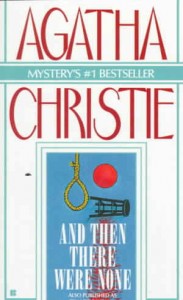
I actually found it difficult to choose just one to be my favorite. As I mentioned last week, I was really drawn in by Ray Bradbury's short story "There Will Come Soft Rains" (which, I later discovered, was from The Martian Chronicles). But to avoid being redundant, I would have to say my favorite school reading was probably And Then There Were None by Agatha Christie, which I read in 7th grade English. (An extremely close runner-up was Night by Elie Wiesel, but I'll find a time to discuss that one later.)


I think I enjoyed this book as much as I did because I remember it as the first time a teacher treated my class like we could handle things like hearing offensive words and understanding complex subjects. She didn't hesitate to tell us that the book was originally called something else that would be very offensive today, and she had us read some of the more difficult passages in class so we could discuss them together. (After all, how many 12-year-olds do you know who would understand the "swan song" reference? In fact, how many full-grown adults do you know who would pick up on it?)

Beyond that, though, I've never been a big reader of mysteries. I didn't do the Nancy Drew thing (or Hardy Boys, either). So this was the first mystery I read and paid attention to, and it was a very good one. For Christmas the year I read this in school, I received a few other Agatha Christie books (because I had announced my love of this one) but I thought they all paled in comparison to And Then There Were None. It's possible that this was because I was twelve, and I didn't have a teacher explaining the more antiquated references, or it could just be because my thirst for mystery had been slaked with just one.

A few years after I had to read this book for class, I thought about it and realized that I didn't remember the ending. I couldn't remember whodunit! So I found a copy somewhere and re-read it, and was surprised all over again. Unfortunately, I remember it now, but it's still not a bad re-read from time to time.

Cassy's Favorite

While I have read more than my fair share of books during my middle and high school years (half of which I don't even remember now, there were so many), Orwell's 1984 always stood out in my mind.

I think one of the reasons I liked it so much in school was because it was one of the first books I read that wasn't bogged down in language I didn't understand or references I didn't get or topics I didn't really find that interesting.  It wasn't Shakespeare, which, let's face it, most of us had no idea WHAT he was saying in high school (and if you tell me you did, you're lying), nor were there chapters fully devoted to turtles (if you've read it, you know exactly what I'm talking about.)

1984's language is pretty plain and the plot is easy to follow.  Besides, it's about someone constantly watching you, constantly having to watch your back.  There's espionage and trickery and a Government that always knows what you're doing.

And the best part?  It's a book that was easy to discuss, even in high school. Question one: do we live in a world like this now?  The constant debate on what our government watches and the rights we have, even in High School was alluring.

I read this again about a year ago and I realized that I still really love it.  It's a great book and, honestly, I still love it for all the reasons that I did before (and the fact that just after finishing it, one of the engineers I worked with made a Room 101 reference and I got it, just made me love it more.  Especially when I told him I had just finished the book and he, sheepishly, responded that he had only ever seen the movie.)

Alex's Least Favorite
Just like with my favorite school reading, it was really hard to choose between two finalists for my least favorite. I think that really, my least favorites would be the ones that had absolutely no impact on me, because that must have been an enormous waste of time. (I remember that we were supposed to read The Great Gatsby but I remember nothing about it.) And while I really hated reading Things Fall Apart by Chinua Achebe, I don't remember why, so I don't think it would be fair to discuss it here. Which leaves me with Animal Farm by George Orwell.


Wait... Don't get me wrong. I actually kind of liked this book. After the fact.

If you aren't familiar with it, Animal Farm uses a barnyard as a political allegory. That means it's all a metaphor. For those of you who weren't so great with your literary terms, think of it this way. "My room is a pig sty" is a metaphor. My room isn't really a pig sty; it's just messy, like you would expect a pig sty to be. Metaphor! And an allegory is like applying that to a whole book. (It's not a perfect definition, but it's close.)

See, Orwell was a democratic socialist. He wrote Animal Farm to critique Stalinism and a lot of other political stuff that I vaguely remember. It is rife with symbolism and personification and imagery and pretty much every single literary device you're supposed to learn in high school English. Which means you have a lot of content to deal with when you read this book in school.

I'm glad I had to read it for school. Otherwise, I may never have picked it up, or if I did, I wouldn't have understood all the symbolism. But the way it was taught to me ruined it for me. I can only describe it as a mountain of busy work. I would have much preferred being able to focus on reading and understanding the book instead of stopping myself every few sentences to write an entry. (Vocabulary word, part of speech, definition, sentence it is found in, write your own creative sentence using it. Dozens of these per section. At least 150 by the time we were done.)

But, perhaps I'm wrong. Perhaps the reason I can enjoy the book today is because I have all that base knowledge somewhere in the back of my head from completing every word of that busy work.

Cassy's Least Favorite


I, like Alex, had a tie for least favorite.  While I have a special hatred in my heard for Wuthering Heights, I developed most of that hatred in college (mostly because I had to read it back to back semesters, and that was the third time in three years I had to pick up that God forsaken book.)  If we're concentrating on High School books, well, The Red Badge of Courage easily takes the award.


Do you know what I remember from this book?  The color yellow = cowardice.  That's it.  Really, NOTHING happened in this book.  The writing in it was terrible.  Usually, I was a kid who read ahead, but the book was so incredibly boring, the imagery so poorly written, I couldn't bring myself to do it.

The other thing that made me really loathe this book?  The endless paperwork that went along with it.  There were questions, upon questions, upon questions.  Worksheets full of them that we had to answer.  I remember filling in an answer with 'he got amnesia' because I just didn't care.  I got zero points on that question.  But you know what?  I got the stupid worksheet done.

Crane really has one of the worst times in American History at his disposal, and he couldn't even make it mildly interesting!  It took weeks to plow through this book.  And do you want to know the absolute worst part about it?

The book is only 112 pages long.  It feels like it's about 400.

*We apologize in advance for the length of this post.  We understand it's a bit cumbersome, but it's fun.  We promise.