Showing posts with label author:S;. Show all posts

Wednesday, January 29, 2014

Favorite Survival Story

In The Maze Runner, it's all about kids learning to survive, to adapt to their environments, to be very much man against nature (or, in this case, man against The Man.)  Alex and I decided to go ahead with our favorite survival books


Let's face it, there's little that Michael Crichton did poorly.  In fact, even his mediocre books are way better than a lot of people.  But there is something about Jurassic Park that just makes you realize how epic he is.

This book makes such a great modern day meets history survival story.  Not only do they have to fear for their lives and be resourceful and make sure they don't die a horrible death, they have to do all this in regards to DINOSAURS, creatures that we don't know a ton about.  A lot of it is speculation, or based on what we have seen from the bones, but we get a lot of things wrong.  The characters are basically piecing it together from what they know (which, since one of them digs up dinosaur bones for a living, is admittedly more than most.)

The characters in the book are interesting and diverse.  They action is enough to keep you turning pages, but not enough to think it's just too much.  There's death and gore (because what survival story would be complete without it) and just enough to keep you hooked and pick up the sequel.
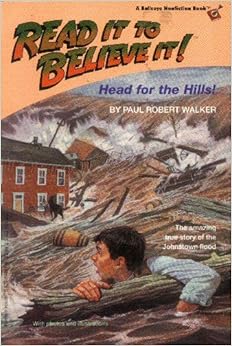


I cannot for the life of me find an image of the cover of the book I'm thinking of, but I do know it exists. (If we weren't covered in half a foot of snow today, I'd drive over to the house where most of my books are stored and dig through them all to find my copy.) But my favorite is a children's non-fiction selection.


The image above is part of the same series, "Read It to Believe It!" There was one that I really loved called "Survive! Could You?" and it had four or five survival scenarios that taught you what to do. That book is literally the only reason I know how to withstand an earthquake or tornado or landslide, despite living in Virginia Beach my whole life, where those things never, ever happen.


But my favorite is the one about Mt. St. Helens (Read It to Believe It: They Survived Mt. St. Helens by Megan Stine) probably because my mom's family is from Oregon and she was alive when Mt. St. Helens blew. It combined stories of people from different areas who were affected differently by the blast. It told about the guy who refused to leave his cabin and is now buried somewhere under Crater Lake. It told about some people who were hiking (I think) and couldn't drive from the river (I think it was probably the Columbia) because it was full of sulfur (and that chapter is how I know that sulfur smells like rotten eggs). I think this was the book that sparked my love of reading about devastating disasters, awful as that sounds.

Wednesday, January 1, 2014

Favorite Biography

Since we're talking about I Am Malala this week, and her autobiography, we decided to talk about our favorite biographies.

The Immortal Life of Henrietta Lacks is a book we've read on this blog.  While technically it IS a biography, it's really seems like so much more than that.  You learn about her life, her death, her family and all the benefits and troubles that having the most famous cells in the world brought.

It was also interesting because it poses such a moral dilemma. Yes, it's wrong to take someone else's cells without their permission.  At the same time, if Henrietta's doctors hadn't done it, there would be so much today that we don't have that are due to her cells.  It's a touching book and heartfelt and is a good balance between the science and the story.

Well, we're starting the year on an easy note, because my favorite biography is also The Immortal Life of Henrietta Lacks!

There is so much in this book. Do you like science? History? Biography? Ethics? This book has it all.

If you want to hear more about what we think of it, we reviewed it in October of 2012.


Tuesday, December 10, 2013

Some YA Books to Buy Your Teen

Ok, so tomorrow we're actually going to be talking about our favorite YA book of all time, but I figured, with Christmas coming up, there are probably a lot of you out there buying for teenagers, or kids getting right into that age.  So I'll save my #1 favorite book for tomorrow, but today, I'm going to give you a list of some great books for teens.


The Book Thief is an AMAZING book about friendship and family and doing the right thing (but on the most extreme level.)  It's about love, and caring, and reading and the importance of all of it in life.  While the book will make you cry basically from start to finish, it's so moving and heartwarming and the perfect book for really any kid between the ages of 12-100.


There's not much by Spinelli that I don't just absolutely love, but Stargirl is probably one of his best.  It's such a great story about being true to yourself, and being who you should be, despite those around you.  The point is happiness, not to make other people happy.  The book is actually from Leo's point of view, telling us the wonderful, and the terrible, ways that he sees Stargirl.


Honestly, I could put John Green on this list about five time (which is about how many books he's written), but I put this one on here, even over Looking for Alaska (my most favorite by him.)  If you're kid is a band nerd, buy them this book.  It's funny, so HILARIOUSLY funny, and most of that humor came from being a band kid for years.  Seriously, this book is for band kids.


You know why I love this book?  This whole series, actually?  Because it's such an awesome portrayal of friendship.  And, if you ask me, a pretty realistic one.  Shit happens, and sometimes, it happens without your friends around.  And sometimes you can only communicate to them through letters and magical pants.  And sometimes your friends are on your side, and sometimes they're on your side, even if you think that they aren't.  But at the end of the day, good friends are always there and give you exactly what you need.


Really, pick anything by Ellen Hopkins ever.  We've always recommended her on here and big reason is that she doesn't lie to kids.  She writes from a very personal place, a place that she saw her daughter in, that sometimes here daughter is STILL in.  If your going to discourage kids from doing drugs, this book is probably the best way to do it, because it's so very real.


I know Unwind has come up on here a lot, but honestly, I can't recommend this book enough.  It is so moving and powerful and, honestly, has one of my all-time most favorite, most powerful and well written scenes I've ever read in my life in it.  Shusterman handles the volatile subject of abortion so perfectly, so powerfully, and so respectfully, that I can't even begin to recommend this book enough.

Stay tuned tomorrow for mine (and Alex's, of course) all time favorite YA book.

Wednesday, November 27, 2013

Favorite Food Book

Since most people's Thanksgivings revolve around food, and Thanksgiving is tomorrow, we're talking about our favorite food-related books today!


There is a whole series of these books by Laura Numeroff. They're considered "circular tales" because, at the end, you come back to what you said at the beginning. If you aren't familiar with If You Give a Mouse a Cookie or any other the others, it goes basically like this: a kid offers the titular cookie to the titular mouse, who requests a glass of milk... then a straw... etc. etc. until he's making ridiculous demands. I always kind of thought the mouse was rude. Like, just be happy with your cookie, dude.

The first several of these books were food related... giving a pig a pancake, and a moose a muffin. Then they expanded out to things like giving a pig a party, and Happy Easter, Mouse! But this is the original, and the only one I remember reading in school.

So mine... sorta counts.  It's not so much about food as it is about a beverage company... but that's ok.


Ok, I will give you that there is a MAD amount of propaganda in this book.  I mean, Schultz is obviously trying to get you to believe that Starbucks is the most super, awesome company in the world.  And while I don't buy into that ideal... it was a good book.

Starbucks has become such a THING in this day and age.  The logo is immediately recognizable and most people buy their coffee from there.  You can even find a large number of people who refer to all coffee in a coffee shop as "Starbucks."

And I will concede that Schultz does run a great company.  They cre about their employees, they care about giving around the world.  They make an effort to have a smaller footprint on the ecosystem, which is awesome.

It was also cool to learn about how so many of the Starbucks staples came to be.  Via, and the exact way that the coffee is made and how Pike Place came to life, and WHY it came to life, is all really fascinating to read about.

You do need to read this book with a bit of a grain of salt, but honestly, I really enjoyed it.  Really, how could anything about COFFEE be bad?

Monday, November 25, 2013

Author Bio: Lemony Snicket

Sure, his real name is Daniel Handler, but Lemony Snicket sounds so much better. Sounds kind of like a cookie to me. Handler says choosing his pen name was probably a Freudian slip, since it sounds very much like Jiminy Cricket, who is the kind of didactic goody-two-shoes narrator he hates (and Snicket is the opposite of that).


This is Snicket's author photo
Perhaps best known for the Series of Unfortunate Events featuring the Baudelaire children, Snicket has written dozens of other works, including the currently ongoing All the Wrong Questions series.


There's also the hilariously titled Lemony Snicket: The Unauthorized Autobiography (think about it a second... you'll get there).

One of his most interesting projects, I think, was when he wrote The Composer is Dead, which is a murder mystery intended to explain the instruments of the orchestra to children. The San Francisco Symphony Orchestra did a live performance with Handler narrating as Snicket. A recording of that performance is to be included with the expanded version of the book.

He has so many other projects, it would be extremely time-consuming and verbose (a word which here means "using too many words to be worth my time") to explain them all to you.

Monday, October 21, 2013

Author Bio: Alvin Schwartz

This week, we're reading a book by Alvin Schwartz. (Not the one who worked on Superman and Batman comics... the children's author.)

After service in the Navy, a bachelor's from Colby College and master's from Northwestern University, Schwartz was a reporter for the Binghamton Press in the early 1950s. He then published a series of books on folklore and wordplay for children.


He is best known for the series from which this week's review book comes, Scary Stories to Tell in the Dark, probably in part due to the original illustrations (which you will hear far more about on Thursday) by Stephen Gammell, and in part due to the book's place on the list of frequently banned/challenged books.

Schwartz also wrote When I Grew up Long Ago, which was for an older audience than his other fare, and described American life in the late 18th and early 19th century.

Schwartz died in March 1992 in Princeton, NJ.

Friday, September 20, 2013

Review Me Twice: I Can Lick 30 Tigers Today! by Dr. Seuss

This week, we've been talking all about Dr. Seuss.  We decided to review one of his lesser known books, I Can Lick 30 Tigers Today! And Other Stories.

It's a fun book, especially if you're thinking in terms of kids, because The Cat in the Hat (he's not named that, but he looks identical TO the Cat in the Hat) spend the whole book thinking up excuses NOT to lick 30 tigers.  One gets dismissed because he has curly hair, another few due to dirty fingernails.  I mean, it's just completely nonsensical.

The rhyme scheme is a little different than his other books (usually it's aabb or abab.  This one is abba).  Honestly, I think that it doesn't flow as well as his other books.  It doesn't have that "beat" that you find in books like The Lorax.

Later on the rhyme scheme changes, for my favorite story in the book.  It's this little girl who thought a Glunk up (he was a Glunk that got Thunk.) and she has to try and unthink him because he's doing all of these terrible things.  One of them is calling long distance, which just made me chuckle because that's not really a thing anymore.

I also like that Dr. Seuss makes up words and it's completely fine.  Like Glunk, for instance.  The man made it up because it rhymed with thunk and you know what?  I'M TOTALLY OK WITH THAT.  It works and I buy it and his made up words are just so natural, you almost think that they should be real.

The book wasn't my favorite Dr. Seuss, but it does certainly make you realize why the man became so ridiculously famous.

What a mild disappointment. I thought that this would be some untapped gold mine of Seussian greatness, but it wasn't, really. Just more Seuss. And if someone was really, really into Seuss, that would be a great thing. I'm not, so it was just a little more of something I enjoy to a degree. So that's good, I guess. (Do I sound underwhelmed? I was underwhelmed.)

I do have to admit that, knowing that this was Seuss, I thought the title literally referred to licking tigers. Like, with one's tongue. I know it sounds weird, but look at absolutely any other Seuss book and you'll understand why I thought that was the case. But really, it's the antiquated slang version of "lick," as in fight them successfully, beat them up, pound them to a pulp, pulverize, contriturate (yes, I went to the thesaurus for that one). But to be fair, the book is from 1969.

Saturday, August 10, 2013

By Its Cover - Richard II by William Shakespeare

Welcome to a special edition of By It's Cover.  BY IT'S ACTOR!!!

Really, let's face it, there are a million and one covers to Richard II.  Annnnndd, since it's 10 PM the night before this post is due to go up and neither I, nor Alex, has actually written up the BIC, it probably means we're not really looking forward to it this week (because there are a million covers... and they're all kind of boring.)  So this week, I'm just posting a bunch of pictures of actors who have played Richard II (mainly because there's no one around to stop me.)

Alex may join in if she likes with any actors I missed... or maybe actresses.


This is Ben Wishaw.  He played Richard II in a very recent BBC version of the play.


Derek Jacobi played Richard II in 1970.  Probably a little old for the part, but very distinguished, nonetheless.  He was also on an episode of Dr. Who in 2007.


Mark Rylance portrayed him in 2003.  Again, Richard was very young, but I'm getting the feeling Hollywood is missing that point... as they usually do with these kind of things.


Waaaaiiiit a second, that's a girl!  Indeed it is!  Fiona Shaw (AKA Aunt Petunia), played Richard in a 1997 version of the play.  I don't know if it was any good, but it's certainly an interesting take on the whole thing.

At the risk of sounding lazy, I'm only going to add that Cassy did a great job and I have nothing to add!


Saturday, July 13, 2013

By Its Cover: Le petit prince


Even if you've never read the book, you've probably seen the cover. (At least, you did yesterday, if not before.) It hasn't really changed in the 70 years since it was published.

That is, of course, the titular prince on the cover, and he's standing on his planet (which is to scale... it's actually very small). Most versions of the cover have a blue background to make it clear that he's in space, on his little planet.

It's a fairly direct and literal cover, and I'm cool with that. I think the hat/boa picture might make a better cover (see my review in yesterday's post) but this is still fitting.

I don't have much to add to Alex's critique.  Mine had the blue background that she speaks of.  Also, I like the font.  It's very whimsical and this is a whimsical book.

Wednesday, July 10, 2013

Favorite International Book

Because we're reading an originally French book this week, we are picking our favorite international books. Since that's a vague descriptor, let's say "international book" means something originally written in language other than ours, and/or is about/from a culture very different from our own. (Therefore, what constitutes an "international" book varies by person.)


We've discussed Marjane Satrapi's Persepolis and Persepolis 2 on the blog before, but it is the first thing that comes to mind when I think about the parameters set above for an international book.

I really learned things about a culture other than mine that - before picking up these books - I knew nothing about. I also identified with characters who are very different from me. These are the marks of a good international book: bringing readers and writers/characters together despite their many differences.

If I had to pick a favorite book of all time, Les Liaisons Dangereuses, or Dangerous Liaisons in English, would probably be that book.


It takes place in France in the late 1700s.  It's about two rivals (Madame de Tourvel and Vicomte de Valmont), who use sex to get whatever they want in life.  Which, in the 1700s, to write a whole book about sex... well, that was a HUGE deal (And in fact, in the beginning of the book, there's an editor's note that says it was all the idea of the author, and an author's note that says it's all the idea of the editor, who subsequently were both LaClos.  He did it so that he could simultaneously take credit/deny any accusations, depending on how the book did.)

The two decide to make a bet to basically see who's the better seducer (also, so Tourvel could take revenge on an old boyfriend), and the whole thing just goes crazy from there.  The book is told through letters between the characters, so it's even more interesting because you don't actually see anything in real time.  It's all tainted by the narrator of the letter (remember Alex's post on unreliable narrators?  This book is the best example you will ever find of that.)

The book was originally written in French, and you learn a lot about French 1700s etiquette (which, while not so relevant today, is still really fascinating.)

Really, the book is just awesome and fascinating and incredibly well-written. 

Monday, July 8, 2013

Author Bio: Antoine de Saint-Exupery

If you think the author of this week's review book, Le Petit Prince (or The Little Prince) has a mouthful of a name, consider that his full name is Antoine Marie Jean-Baptiste Roger, comte de Saint-Exupery.


Born June 29, 1900, Saint-Exupery was not only a writer but a French aristocrat (thus the long, fancy name) and a pilot, too. He failed his finals at the Naval Academy twice (though it was rumored that this was intentional) and went to study architecture, but didn't finish that program either.

In 1921, he joined the military service in the French Army. While deployed, he took private flying lessons and was transferred to the French Air Force the next year. After a crash, his fiance's family (a girl he, subsequently never married) insisted that he leave the service and take an office job, and he did.


But by 1926, he was back in the sky, paving the way in the field of international postal flight. Also that year, he published his first novella, L'Aviateur (The Aviator).

In 1929, he published his first novel, Courrier Sud (Southern Mail), but he didn't begin to be recognized for his writing until he published Vol de Nuit (Night Flight), about his experiences flying for Aeropostale (not the clothes company) Argentina in 1931.

On December 30, 1935, Saint-Exupery crashed his plane in the Sahara Desert while trying to break a speed record between Paris and Saigon. He and his mechanic-navigator survived the crash, but became dangerously dehydrated. 


Big place... kinda hot and dry.
On their fourth day stranded, a Bedouin on a camel found them and saved their lives. Saint-Exupery wrote about this harrowing experience in his memoir, Wind, Sand and Stars (1939). There are also references to this experience in Le Petit Prince (1943).

He lived in New York City from 1941-43 (which is actually where he hyphenated the "Saint-Exupery," after great frustration over Americans calling him "Mr. Exupery"). While in America, he wrote Pilote de guerre (Flight to Arras) and Lettre a un otage (Letter to a Hostage), the latter written for the French living under Nazi occupation at the time.

In 1942, he met a precocious little boy in Canada, who inspired him to write Le Petit Prince, published in 1943. It was published in French and English, but only in America, until after the liberation of France, at which point it was published there as well. Today, it is published worldwide, in many different languages. 180 languages to be exact, on of with is Toba, and obscure northern Argentinian language. 


Saint-Exupery returned to his piloting in 1943 with the Free French Air Force to fight alongside the Allies in the Mediterranean. He was assigned to a recon mission around the Rhone Valley, on which he disappeared. A French woman reported seeing a plane crash, and an unidentifiable body was found wearing French colors several days after his disappearance.

In September of 1998, a fisherman found Saint-Exupery's identification bracelet hooked on a piece of cloth (presumably his flight suit), but it was far from the flight path he should have been on, bringing many to doubt its authenticity. Nevertheless, it was an emotional discovery for France, as they revere Saint-Exupery for both his writing and his piloting.

In May of 2000, a diver found the remains of Saint-Exupery's plane (which was recovered in 2003). There is much speculation about the circumstances of Saint-Exupery's disappearance and subsequent death, but not much is for certain.

Much of his writing was published posthumously, many of which are written as a series of letters.


There are monuments and historical markers everywhere he lived. He is recognized in a number of museums, in theater and film and music, in the naming of schools, streets, and buildings, and his face appeared on the 50-franc banknote.  In 2003, a small asteroid moon was named "Petit-Prince" after the book. He is well-beloved by French and others alike.