Tuesday, November 6, 2012

Election Day

Americans! It's Election Day! I won't harrass you about how it's your citizenly duty to vote for the next leader of our fine country, because that's really annoying.

Instead, I'm giving you the gift of information about the less-celebrated presidents. Everyone knows things about Washington, Jefferson, Lincoln, etc. But most people forget we even had a president named Pierce, or who followed up Woodrow Wilson. Obviously, who is "less-mentioned" and who is not is subjective, but let's just call this a sampler. (After all, I have to get back to my NaNoWriMo-ing sooner than later.)
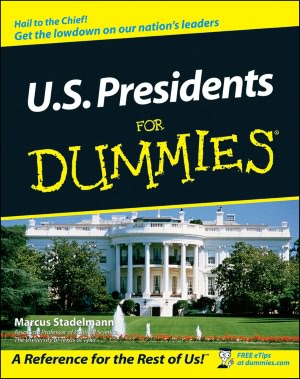
U.S. Presidents For Dummies
Not the most well-versed person you know regarding U.S. presidents? Maybe you want an overview of the whole list. U.S. Presidents for Dummies should do the trick.

Martin Van Buren, 8th POTUS (1837-1841) (Free Soil Party)
Is your lucky number eight? Van Buren's was, because he was the 8th VP and the 8th President of the US. (I know that's confusing, but the VP terms were confusing back then.) The "big thing" of his presidency was the Panic of 1837. His opponents blamed him for this economic hardship and referred to him as Marten Van Ruin.

Millard Fillmore, 13th POTUS (1850-1853) (American Party)
President Fillmore didn't have a Vice President throughout his entire term. He is consistently ranked as one of the bottom ten presidents (but to be fair, there have only been 44... nearly a quarter of them have to be the bottom ten on any given list). He co-founded the University of Buffalo. He was born in a log cabin like a certain tall-hat-wearing president but nobody seems to make a big deal out of it for Fillmore.

Franklin Pierce, 14th POTUS (1853-1857) (Democratic Party)
Frankie was referred to as a "doughface," which was the 1850s way of saying he was a Northerner with Southern sympathies. His VP, William R. King, died about a month after inauguration, and Pierce served the rest of his term VP-less.

Rutherford B. Hayes, 19th POTUS (1877-1881) (Republican Party)
The B stands for Birchard, which was his mother's maiden name. His election caused the Compromise of 1877, where the Democrats allowed Hayes to accept the Presidency, and Hayes allowed the end of the military occupation of the South. He served in the Union Army during the Civil War.

Chester A. Arthur, 21st POTUS (1881-1885) (Republican Party)
The A stands for Alan. He took over the presidency (after about 6 months as VP) when James A. Garfield - whose A stands for Abram - was assassinated. He did not get his own VP. He also fought in the Civil War.

Benjamin Harrison, 23rd POTUS (1889-1893) (Republican Party)
Benjie was the grandson of slightly better-known president William Henry Harrison. He is - so far - the only president to be the grandson of another president, and also the only one to be from Indiana. He died of influenza.

Warren G. Harding, 29th POTUS (1921-1923) (Republican Party)
Harding coined the phrase "founding fathers" when he used it at the 1916 Republican National Convention. He is lesser-known because it was his job to return things to normal after WWI, so he didn't shake up the country.

I feel like the rest of the presidents (from Calvin Coolidge onward) are fairly well-known because they're in more recent memory, so I'll stop there.

Monday, November 5, 2012

Lambda Literary Award

This week's book-to-review is Rainbow Boys by Alex Sánchez. He is also the author of So Hard to Say, which won a Lambda Literary Award in 2004 in the children's/young adult category.


The Lambda Literary Award (also known as the "Lammys") was instituted in 1988. It exists to celebrate LGBT literature. (If you're unfamiliar with the acronym, it stands for Lesbian, Gay, Bisexual, and Transgender/Transexual.)

For the 2011 awards, there were 24 categories. A list of winners since the award's inception can be found here. The Pioneer Award (winners listed below Lambda winners at that link) celebrates individuals who have broken new ground in LGBT literature and contribute to the LGBT community in significant ways. The Pioneer Award was started in 1995.

Also, on the Lambda Literary website, you can: donate to their scholarship fund; volunteer; join a book club; or learn a lot more.

(Disclaimer: We aren't associated with the Lambda Literary Award in any way; we're just here to inform.)


Friday, November 2, 2012

Review Me Twice- Seriously... I'm Kidding by Ellen DeGeneres


This week, Alex and I decided to read Seriously... I'm Kidding by Ellen DeGeneres.  While this is technically another non-fiction book, it's really very different than what we covered last week.  Obviously, it's a lot more humorous.  Ellen is a comedian (which, unless you've been living under a rock, I'm sure you already knew.)  Really, this book is an insight into her life and thoughts, things she does everyday and what she really feels about life.

During certain parts of the book, she talks about some really serious things.  She discusses how she and Portia like kids but don't intend to have any of their own.  She has a chapter that she devotes to manners and how a lot of people don't have them anymore (which, is really my favorite chapter because I completely agree.  People don't even give you simple thank you for things these days.)  She talks about how we don't get out of the house and do things and our attentions span has been shortened.

However, it still has that Ellen wit.  She makes jokes (even the inside flap is funny.)  She has an entire chapter for the audio book where she writes out weird noises and we only have to guess as to what they would sound like on CD.  If you've ever watched her show (like the hilarious clip below), you will see that she is just a funny person.


However, here is my major criticism of the book.  If you are a comedian, someone who I know and love and I think is hilarious, then your book better be, well, hilarious.  I'm not saying the whole thing was dull, but I expecting so much MORE from her.  I expected my sides to be in stitches from laughing so hard.  I expected every chapter to have more jokes than I could handle and, to be honest, I just didn't get that.  Ellen is the type of comedian that she's funny because of her delivery and she isn't a strong enough writer for that delivery to come across the page.  It wasn't that the material wasn't funny, it was that it just wasn't funny on a page without anyone delivering it to me.

That being said, I think this book could have been a lot better if I got the audio version.  I hardly EVER advocate an audio book over the actual book, but Ellen actually reads her audio version and I think the book would just be better with all of the jokes being told as they were meant to be.

My Bottom Line 2 1/2 out of 5

I love Ellen DeGeneres. I don't watch her show and I haven't read her other two books but I do like her quite a bit. I think she's funny, smart, witty, and stands for some very positive things.

I really liked this book. I won't say I loved it because that's something I say about books I'll read over and over again, which I wouldn't do with this book. It was great, and I enjoyed it very much, but once through was enough.

My favorite chapter was "The Chapter for Audiobook Listeners" (even though I was reading a regular print copy). It was very funny, but I won't tell you why, because you should read it yourself.

The best part of the book is that it feels very much like Ellen is talking to you from the page. She wrote it to be that way (writing like she talks, addressing you - the reader - directly) and it works, and I liked it.

Short story: I like it, it's not for reading over and over, and I like the author more than I liked the book (but that isn't saying much because I really like the author).

Thursday, November 1, 2012

NaNoWriMo


It is the first of the month!  And that means it is officially National Novel Writing Month! (in fact, I am making sure that this posts at midnight, eastern standard time, because I'm awesome.)  Now, I know that I'm usually on Tuesdays, but Alex asked for the Tuesday slot this week because she wanted to do something Halloween related, which was actually great, because that meant that I could kick off NaNoWriMo on the first.

Now, let's face it, if you're reading this blog you're either A. friends with Alex and I and know what this is because I participate in it every year (and Alex the years she can) or B. you probably participate in NaNo yourself.  But, on the off chance that neither of these things are true, let me tell you what Nano is.

As the picture at the top of my post suggests, it starts on the first of November and ends on the 30th of November.  You have 30 days to write 50,000 words, about the length of a novel.  Nano has around 300,000 writers and the official website is www.nanowrimo.org.

Now, Nano isn't just something that's done for fun (though, it is fun, if a bit intense.)  It's basically a big huge fun promotional month for the Office of Letters and Light.  They are a nonprofit organization that promotes writing programs for youth in schools, mostly.  They do programs like Camp NaNoWriMo and Young Writer's Program, which encourages kids and teens to write.  Really, their goal is just to promote literacy and writing and do whatever they can to help kids learn to read and write.  They're really a great organization.

If you're a writer and you've been living under a rock for the past 10 years or so, Nano is a great way to challenge yourself.  50,000 words comes to about 1667 words per day.  That doesn't seem like a lot but there are days that nothing comes to you.  You get stuck.  There are days that you just don't want to write.  And some days you just write complete crap.  But that's the point.  The point is not to stop.  The point is to write 50,000 words, even if it's 50,000 words of crap.

So this month, every Tuesday, I'm going to be giving NaNo tips.  If you decide to embark on this journey with me (which I will be doing diligently.  This will be my fifth year and I have won all the years previously; I don't plan to stop now) then I'll be here with some fun anecdote, some free advice and just some stress relieving techniques.

Happy NaNoWriMo, Everyone!

Wednesday, October 31, 2012

Favorite Villains

We thought that, in honor of Halloween, discussing our favorite villains would be appropriate.

It's really hard for me to pick a favorite villain, because I so often find myself liking the villain more than I like the protagonist. I know why, though: Protagonists - especially in YA fiction - are supposed to be placeholders. You're supposed to be able to easily pull Harry Potter or Bella Swan or Eragon out of their books and drop yourself in and live the adventure through them. That's how those books work. This means that the authors have more leeway to create villains than they do with protagonists. Villains can have intricate backstory and strong personality traits and intense characteristics that the good guy isn't supposed to have, because it would make him less of an "everyman."

A lot of the villains I really like aren't true "villains" either. I like gray area. The best villains aren't pure evil, cackling maniacally and/or giving an overwrought speech about his evil deeds or plans while the "good guy" is hanging on for dear life. They make a bad decision that turns out worse than they expected, and they have to figure out how to deal with the consequences. Or they are former "bad guys" who are rehabilitated and have to contend with what that means for them. Or they are given a rare opportunity and do the less-than-noble thing, which most of us wouldn't want to admit to, but would probably do in the same situation.

With all that long-winded explanation, I can finally tell you... I really like Doctor Dee / Doctor Destiny / John Dee from Sandman: Preludes and Nocturnes. (Cue the groaning by everyone who knows that Neil Gaiman wrote that, and is sick of me talking about him and his work.)

Dee is pretty evil. You don't expect a nice person to say things like "I think I'll dismember the world and then I'll dance in the wreckage." (You also don't expect sane people to say things like that, and Dee was being held in Arkham Asylum, so you can take his dialogue with a grain of salt.)

I don't want to give anything away, because every panel (it's a graphic novel, remember) is a gem. But the best part of his story arc is when he holds hostages in a diner for 24 hours. It's great writing and great artistry and it's just wonderful in a terrible way.

He's a DC Comics villain, but I'm not familiar with anything he's done in any other comics, so I can't speak to those.


On the left: Doctor Destiny as you may know him from the Justice League. On the right: Dee as he appears in Sandman: Preludes and Nocturnes.

My favorite villain is from Disney (cue the collective groans) but it's from back in the day when Disney knew how to do it right.  I love Maleficent.  I think she's great and conniving and excellent.  She's the classic example of a woman scorned.  She really has no scruples.  Think about how long she held a grudge.  She waited sixteen years for her revenge.  I mean, that takes some patience.  All because she didn't get invited to a christening.

And she did some intricate planning, too.  Briar Rose had to prick her finger on a spindle, where she fell asleep and her prince had to hack his way through a thorn filled rose patch to get to her and wake her with a kiss.  That is, after he fought Maleficent who turned into a large and fearsome dragon.   

Disney's Sleeping Beauty isn't the first place that Maleficent shows up.  We first see her as a wicked fairy godmother in Perrault's original Sleeping Beauty (which, if you get the chance, you should read.  It's very naughty and dirty and not at all fit for children.)  She then showed up again in Tchaikovsky's ballet Sleeping Beauty, but her name was Carabosse.  The story for all of these fairy tales is the same; Maleficent curses Briar Rose, the prince has to rescue her and Maleficent has to fight him.


Inevitably, she always loses, but she's one of the most powerful witches, one of the most alluring and one of the most vicious fairy tale characters.


Tuesday, October 30, 2012

All Hallow's Read

A librarian friend of mine posted this on Facebook recently. Since Halloween is tomorrow, I thought I needed to share this with you, our dear readers.


If you can't watch the video because you're at work, or your smartphone is too slow, or you just don't want to, I'll take a shot at explaining it (but I promise, the video does a better job).

All Hallow's Read is the Halloween tradition that was just waiting to happen. Here's how you participate: Give someone a scary book. Seriously, that's it. You can still do what you normally do for Halloween: give out candy, dress up, drink heavily, ignore the whole holiday entirely... whatever. But give a friend, family member, coworker, stranger, or someone else a scary book.

For more information and/or book recommendations, check out allhallowsread.com


(No, we aren't affiliated with them in any way. I just thought this was a neat idea and wanted to share it with you, our dear readers.)

Monday, October 29, 2012

eBook VS Real Book

 VS.  


It is the age old battle of digital vs. physical, eBook vs. real book, New age vs. Old age.  Today, Alex and I are going to be discussing benefits and drawbacks of both eReaders and physical books.  And while there will be hard core facts about both, this will mostly be our opinions.

First and foremost, you should know that Alex and I both own an eReader (Kindles for both of us.)  When we talk about eReaders, we're mostly going to be referring to those because that's the eReader we have experience with, but at the end of the day, there's not a huge difference between you're basic eReaders.  Storage wise, performance wise, visually, they all really do the same thing for you if you're looking for your basic, black and white, no nonsense eReader.  When choosing an eReader, my suggestion to you is to pick it from the company you trust/use the most.  If you use Amazon a lot, earn a lot of credit there, buy a Kindle.  They're great, great customer service and they back they're products up very well.

However, if you frequent Barnes and Noble a lot, you have a B&N card, you get credit/discounts there, then by all means, go with the Nook.  I'm not going to sit here and tell you Kindle is OH SO BETTER, because it's not and honestly, the prices are pretty comparable. I would actually probably have a Nook if I had been buying myself an eReader, but I received my Kindle as a Christmas present, and I love it, so I didn't bother switching. The only big difference is, the original Nook and standard Kindle have B&W screens that are much better for your eyes, while Kindle Fire, Nook Color and iPad are all back lit and can be very hard on your eyes, not to mention difficult to read in the sun. 

However, I'm here to tell you things about eReaders.  Good things:  

  1. They're very light these days.  You can stick them in any purse or bag or whatever and weigh MUCH less than a book.  
  2. What's more, they hold literally HUNDREDS of books.  You can borrow eBooks from your library and you can usually do it from your eReader.  
  3. Read all the books on your eReader?  Who cares?  Pop online, buy a book, read it.  What's more, there are hundreds of books that are free and thousands more under $10. You can also download eBooks from most libraries for most eReaders. Different libraries use different eBook providers, and the details vary, but most of them are compatible with iPads, Kindles, Nooks, and Droid tablets. 
  4. You can read the eReader on the beach, in the sun and now, with the new Kindles with the lights built right into the eReaders, you can read in the dark with the screen that is easy on your eyes.


Cons?  

  1. Well, if you're not careful about your battery, you can take out the eReader one day and the battery is dead and you have nothing to read on that long train ride.  That will never be a problem with a book.  
  2. If you leave an eReader on a train, you're out $150.  If you lose a book, you're out $7 for a paperback, $20 for a hardback.  
  3. eReaders become outdated technology, eventually.  Every few years we have new Kindles and new Nooks.  The worst with a book is waiting for the paperback to come out so you don't have to spend $20.  
  4. And you don't get that book feel.  I get it.  There's nothing like feeling a book in your hand.  And the smell. Mmm, book smell. I LOVE BOOK SMELL. Did you know they've bottled it?  I did, actually, but I didn't have $100 to spend on it.  If someone wants to buy me eau de book for my wedding, I will not protest.
  5. Also, eReaders are a contributing factor to why our libraries are going out of business. Alex the librarian respectfully disagrees. We provide eBooks too (like I mentioned before) and they're usually a lot cheaper for us to get. They also don't require maintenance (as in rebinding or shelving or things like that... we do have to make sure the databases work, but that's about it). About half the librarians I know have eReaders, and we love them. A lot of libraries actually lend out eReaders, sometimes pre-loaded with content. I could go on, but I think you all get the point.  Ok, well, I'm wrong.  But still, if we eliminate the print book for the eReader, where does that leave libraries?  I'm not saying they're THE reason, I'm just saying, they're probably not helping.  But, clearly, Alex is probably more knowledgeable than I on the subject.


So that brings us to book, the paper, physical, real life thing book.  Pros: 

  1. Books are physical things.  You buy a book and it's yours and you never have to worry about it.  You paid $7 for that physical book and it's substantial, unlike an eBook which... is not.  And we all - well, some of us - remember when Amazon had their little freakout over 1984 and everyone who had downloaded it lost it suddenly one day.
  2. There's just something about holding a book in your hand: the feel, the smell, the ability to turn the pages.  And we don't recommend spraying your eReaders with this stuff.
  3. Buying books also gives you a library of your own (not to mention supports libraries themselves.)  There's just something about being able to walk into a room and seeing books line the shelves, books that have been your friends.

Cons:

  1.  Books are heavy.  Whether you're toting a book from place to place or you're moving them from one house to another, they weigh a lot.  How many times have you gotten rid of books just because you didn't want to have to pack them up?  This is actually one of the reasons I'm such a big fan of the shift to eBooks for textbooks. No student wants to carry around half a ton of textbooks every day.
  2. Books also go through wear and tear.  You read a book a lot and it starts to fall apart, show its age until, finally, it has to be replaced.  One day, you will have to shell out another $7.  Same thing if it gets lost, stolen or borrow forever by a friend.  You're now buying that book you already bought (I have a book I've bought no less than three times because I've lost it through lending and moving.)  
  3. When you travel, you have to bring multiple books.  I know that I can blow through a book pretty quickly, so I have to bring no less than three books with me.  That's three books taking up precious suitcase space.

I actually like both.  Will an eBook ever replace the real thing for me?  No, never in a million years.  I still frequent my library, have books of my own and, when I'm at home, always have a physical book in my hand.  However, my eReader is great for work.  It's great for when I'm traveling or, if I'm early for something, I can just pull it out of my purse and read a book. And if you have one of the newer eReaders like the Kindle Fire (I have the older version with a keyboard at the bottom) you can do other things, like play Angry Birds or check your email, since they're really just tablets with the capacity for storing a bunch of books.  Alex, this is a book blog.  We're supposed to be encouraging reading. If I'm caught somewhere unexpectedly, I have a book on me and I don't need to add tons of weight to my purse to have a book.