Tuesday, December 11, 2012

Cherie Priest

I thought that, since we covered steampunk on Monday, I'd take the time to talk about our author this week, Cherie Priest!


Cherie Priest was born in Tampa, FL and currently resides in Chattanooga, TN.  She has an M.A. in rhetoric and professional writing and did a few years of writing for a blog and now is a staff member of Subterranean Press.

Boneshaker was actually not her first novel, though it was her most famous to date.  It's what she's currently known for.  However, she had a novel, a series of them actually, before Boneshaker ever came about.

  • Four and Twenty Blackbirds,
    • Original edition, 2003 
    • Re-released in a revised, much expanded, edition, 2005
  • Wings to the Kingdom, October 2006
  • Not Flesh Nor Feathers, October, 2007


She won the LuLu Broker prize for this series.  It actually is heavy in the horror genre, much of what Priest wrote before she began to dabble in the steampunk genre.  Between her first book and Boneshaker, she actually wrote numerous amounts of short stories.


  • 'The Heavy', a short story. Published in Apex Digest Issue #12, March 2008.
  • 'The Target Audience', a short story. Published in Noctem Aeternus January, 2008.
  • 'Following Piper', a short story. Published in Subterranean Digest issue #6.
  • 'Little Wards', a short story. Published in The Edge of Propinquity . June 2006
  • 'The Immigrant', a short story, part of Mythic #2, October 2006 Mythic Delirium Books.
  • 'Bad Sushi', a short story. Published in Apex Digest, Issue #10.
  • 'Wishbones', a short story, part of Aegri Somnia. December 2006 Apex Digest. 
  • 'Tanglefoot', a short story, published online by Subterranean Press, 2009. First release of the Clockwork Century universe.
  • 'Hell’s Bells,' Grant’s Pass, Morrigan Books 2009
  • 'The Catastrophe Box', a short story Son of Retro Pulp Tales, Subterranean Press 2010
  • 'Reluctance', a short story, part of "The Mammoth Book of Steampunk", first published in the UK by Robinson, an imprint of Constable & Robinson Ltd, 2012

In 2009, she came out with Boneshaker, the book that we're going to be reviewing this week.  Since 2009, she has written four other novels in the Boneshaker universe, though it was Boneshaker that really caused her writing to take off.

  • Boneshaker, October 2009
  • Clementine, July 2010
  • Dreadnought, September 2010
  • Ganymede, September 2011
  • The Inexplicables, November 2012

Priest actually keeps a very consistent blog.  From there, you can access her twitter account, her Livejournal, her Facebook, her Flickr stream, her Goodreads page, her Youtube channel, and her Google+ account.  She is probably one of the most well connected writers to her fan base, not to mention significantly busy keeping up all those venues.  Those are probably the best places to find out more about her, her writings and her tour dates.

Happy Reading!

Monday, December 10, 2012

What is Steampunk?

This week we're reviewing Boneshaker, which is a steampunk novel.  Steampunk has actually had a pretty recent uprising, though it's been around, technically, since the 80s.  It is a piece of work that takes place usually in the 19th and very early 20th century and is a mixture of history and industrialized west.  It's like a genre mashup (which, if you recall from this post, is becoming ever more popular). It can be either post-apocalyptic or just an alternate form of history.

The major steampunk influences are actually a little surprising: H.G. Wells, Jules Verne and Mary Shelly are the forerunners of steampunk, the first authors to mix the industrialized west into their novels.  Technically, they aren't TRUE steampunk because, well, they were writing about their own time periods, not history, so it's a little different.

Literature is a HUGE medium of steampunk now.  Some big ones are Scott Westerfeld's Leviathan or Phillip Pullman's His Dark Materials.  Both of these take history and combine it with machinery.


This is Westerfeld's Novel.  See all the neat gears?
Can't you just hear the clunking and whirring from there?
Steampunk has a lot of fun, anachronistic onomatopoetic opportunities.

So where did the term steampunk come from?  It was actually in response to this unknown sub-culture rising.  Cyberpunk was huge in the 80s and here comes this movement, based very much on the Victorian age with a dash of gears and machines thrown in.  K.W. Jeter (a sci-fi author) actually coined the term, in a very tongue in cheek letter that he wrote to Locus magazine:

Dear Locus,

Enclosed is a copy of my 1979 novel Morlock Night; I'd appreciate your being so good as to route it Faren Miller, as it's a prime piece of evidence in the great debate as to who in "the Powers/Blaylock/Jeter fantasy triumvirate" was writing in the "gonzo-historical manner" first. 


Though of course, I did find her review in the March Locus to be quite flattering.Personally, I think Victorian fantasies are going to be the next big thing, as long as we can come up with a fitting collective term for Powers, Blaylock and myself. Something based on the appropriate technology of the era; like 'steam-punks', perhaps.

—K.W. Jeter
(courtesy of Wikipedia)

Now, we see steampunk everywhere.  Will Smith did the movie Wild Wild West, SyFy's mini-series Tin Man and of course, the movie The League of Extraordinary Gentleman.

Steampunk is also a huge cosplay movement.  People dress up and get some really intricate costumes.

This is pretty typical steampunk outfits: browns and grays and gears.

Steampunk has really permeated pop culture.  It's in books, movies, even music.  People have steampunk weddings even. If you have several hours to kill and nothing better to do, you could get trapped under an avalanche of results by searching for steampunk on Etsy. It's become it's own culture and movement.  And are we surprised?  It lets us recreate history in a unique way and has a fascinating style to go along with it.

Friday, December 7, 2012

ReviewMeTwice: The Unbearable Book Club for Unsinkable Girls- Julie Schumacher


I always seem to like books that, while reading them, I know are going to fall onto the banned books list.  If this one isn't already on the list, you can be certain it will be.  It talks about sex and drugs and smoking and sneaking out of the house and all the fun things you're really not supposed to do as a teen but inevitably do anyway.

Adrienne is stuck home all summer, due to a bum knee, and her mother forces her into a mother-daughter book club with a group of girls that she doesn't really know.  Jill, CeeCee and Willis are all forced to come to, starting on this book club they all come to regret a little.

My favorite part of this book?  The inordinate amount of book references.  You get at least one a chapter and I just adored it.  It's what I like to call a "smart book."  You have to be well read to get a lot of the references and I love books that do that.  It could essentially be entirely different experiences based on how many books you've read.

I also liked that, by the end of the book, there are still a ton of questions.  I thought that this book was going to be really predictable, but it surprised me by... not being that way.  There were things that happened that I didn't see coming at all and other things that I expected and didn't happen.  Usually, I hate unanswered questions but this was not the case.

I loved that it was four, independent girls, trying to figure themselves out.  They stood up to parents, snuck out of houses and generally were up to no good.  I love that some of the girls are good, but end up pushing boundaries and others kind of toned it down.  

The only thing I didn't like (which, is really minor) is that Adrienne has a busted knee and still does all this stuff she just... wouldn't.  She climbs things, walks for miles and all that happens is that it gets a little inflamed.  Take it from someone who has had broken bones: even when the cast is off, things like walking hurts.  So I couldn't see her walking so much.  It really bugged me.

I really recommend this to high-school aged girls.  It's a great book and interesting and the characters are really relatable.

My Bottom Line 4 out of 5


When I finish reading a book and announce that I am done with it, and someone asks me "so, how was it?" and I say "I don't know," that is a bad sign.

Good: Realistic characters.
Bad: Overly realistic characters.
By "realistic characters," I mean characters with believable characteristics who behave in a way you might expect a real person to behave when put into the situations that character faces. By "overly realistic characters," I mean characters who are just as bland and boring and predictable as a person in real life. Book characters are meant to be held to a higher standard of "being interesting" than real-life people. Adrienne (our protagonist, if you can call her that) admits and laments in the first chapter that she is boring and has no real characteristics. Awesome! Tabula rasa! Let's have a coming-of-age story wherein she learns all about herself through the catalyst of the book club and the bonds she forms throughout the- Wait, at the end, she's still the same bland person who happened to do some uncharacteristic things over the summer? Never mind.

Good: Realistic depictions of relationships.
Bad: Putting them next to awful ones.
I love the relationship between Adrienne and her mother in this book. It's the most realistic depiction I've ever read of a mother-daughter relationship. They neither gush over each other like sappy models of the ideal parent-child pair, nor do they despise one another with all the bile of a thousand angry honey badgers. They get along pretty well, but not all the time. They argue and pick at each other, but not all the time. They keep secrets from each other, but not all the time. Then you put that next to relationships like the dominating CeeCee controlling the submissive Adrienne all summer, or anyone talking to Wallis, the social pariah of the group. It's confusing and I don't know what else to say about it, but I needed to bring it up.

Good: Fairly ambiguous endings
Bad: Very ambiguous endings
I adore the type of ending where you aren't sure exactly what happened. I live for unanswered questions at the end of a great book. (If you aren't sure what I mean, think of Inception.) But this book answered nothing. Absolutely nothing. I would cite examples and apologize for spoilers, but they wouldn't be spoilers because there's nothing to spoil. There is one big thing near the end, and it might be sort of a surprise if you aren't too keen on thinking critically while you read, but I guessed it, and I bet Cassy did, too. (She's good at those things.) So if you like closure or answers, don't get hooked on this one. You will be sorely disappointed.

As disappointed as I was in this book, I don't like putting it down so much, so shortly after NaNoWriMo. I know how much work goes into creating a book, and that it is hard to put one's work out there for everyone to see and judge. So I'll end with the two things I liked unabashedly, the goods without bads to counter them:

Good: Clever chapter gimmicks
I really liked this. Each chapter starts with Adrienne's definition of a literary term, which has to do with what's going on in that chapter. The chapter that defines "dialogue" is full of dialogue (more so than the other chapters). It's clever, and I love it.

Also good: Book references
I like when an author can weave other, well-known books into their own stories. I especially like it when I don't have to have read the other books in order to get it. I've read The Yellow Wallpaper and The House on Mango Street, so I knew exactly what Adrienne was talking about when she referred to them. However, I haven't read The Left Hand of Darkness but I still understood the references because they were well-explained and integrated. (Also, I really want to read it now. That's a very good sign.)

Thursday, December 6, 2012

Tips for Running a Book Club

As promised on Monday, I'm going to give you a few tips that might come in handy if you want to start your own book club.

First, you have a lot of planning to do and decisions to make.


How big will it be? Review Me Twice is essentially a two-person book club where we tell you about the books we read each week. Maybe you want a small group like us. Get a friend or few and keep it small. Or maybe you'd rather have a dozen or more people. Totally up to you (and them).

Age and/or education level. Age of your members is really only relevant if you're inviting minors whose parents might have a problem with certain content. If that's the case, be upfront about the books you're choosing and respect the parents' choices, even if you disagree. Having a common education level among the group is helpful: vocabulary, reading comprehension, reading speed... all of these could cause problems in a group with a wide range of education levels.

Sensitivities. This is difficult to explain concisely, but I'll try. Imagine someone in your book club is a former soldier with PTSD. Do you think you should choose a book set in a violent combat zone? Probably not. There's always the possibility that this person would be fine with it, so you could ask, or you could just read that book on your own time (if you were really interested in it) and choose something else for the group. This applies to a lot of different situations, so just consider others' situations and emotions when selecting your books.

Preferences. Unlike sensitivities, preferences do not need to be tiptoed around. If someone hates James Patterson and you choose a James Patterson book, they will survive. They might not have many nice things to say in your discussion, but they will be fine. Try to be considerate, though, and maybe don't choose another James Patterson book for a really long time. Unless you're starting a James Patterson themed book club, in which case that person should probably join a different book club.

Availability. Remember, everyone has to get their hands on a copy of each book you choose. If they all use e-readers, make sure the books are available via e-readers. If none of them have enough disposable income to buy every book you read as a group, be sure the library has enough copies to cover the group (and that they're likely to be available for everyone to get in time to read it before your group discussion of it). Cassy and I do quite a bit of researching every time we choose a book to review, to make sure we can both access it in a timely manner. (I'm telling you, online library catalogs are one of the greatest technologies of our time.)

Planning. Where will you meet? Someone's house, a coffee shop, a library, a bookstore, an empty classroom? Should you meet online instead? (If so, will it be synchronous or more like a discussion board or forum?) Will it change, or always be the same place? What day will you meet? What time? Will that change, or stay the same? How long will you go between meetings? (Will that be long enough for everyone to access and read the books before discussion? Remember your availability issues.) Will you only meet for book discussion or will there be intermittent meetings? Will you have food at the meetings? Who will provide it? What allergies does the group have? Other food restrictions? Does anyone have a pet allergy that keeps you from meeting at certain people's houses? Are kids allowed? If so, will an activity be provided for them to occupy their time and reduce interruptions? This is only a sample of questions you'll have to keep in mind when deciding all the details of your meetings. You might want to wait until you have all your members sorted out before you start making these types of decisions, because they will want to be a part of the process.

Purpose. This is what you need to decide before trying to recruit members. (Or, maybe you have a group of people already and you need to decide together what you'll be doing in this book club.) Will discussions be light-hearted and more social than anything else, or will you be sharing intense, academic discourse? The books you're going to read: trashy romances, scholarly works, teen fiction, horror, mystery, biographies, or a little bit of everything? (Hint: Review Me Twice is the latter. We want to read everything.)

Records. You might want to keep track of the books you've read as a group. I'm sure you wouldn't wind up repeating a book or something, but this ties in with the next bit of advice, which I'll get to in a second. You don't need to be as detailed or formal as we are: I have a beautiful, color-coded Excel spreadsheet for Review Me Twice, where I keep track of the books we've read, all the posts we write, who chose which book to review, genres, authors, and all sorts of other important things to make sure we...

Mix it up. Remember the hypothetical friend who hates James Patterson up in the "preferences" bit? That friend would really appreciate it if you put a bunch of space between the James Patterson selections, but everyone else probably would, too. You need variety! Just look at the archives for this blog. We've only been doing this for two months, and we've already covered non-fiction, graphic novels, biography, teen fiction (one about parent-child relationships, one about being between a rock and a hard place, and one about homosexuality), comedy, fantasy, and even a modernized rewrite of a classic myth. So keep things interesting and try to broaden your horizons. Cassy and I switch back and forth picking our books; maybe you'll want to pass around the opportunity to select the books for your book club, just to keep things fresh and interesting.

Respect. People have different opinions about things. (I know; newsflash, right?) It seems obvious now, but when you're in the middle of a discussion about a book you feel passionate about (one way or another) you might accidentally say something that sounds rude or demeaning or patronizing or any number of other negative adjectives. Be careful about how you say things, but also be sure to contribute your opinions. People go to book clubs to have fun, learn things, and grow (intellectually, emotionally, socially). So be nice and have a good time.


If you do start a book club, we'd love to hear about it! Tweet @ReviewMeTwice or email us at reviewmetwice@gmail.com to tell us about it.

Wednesday, December 5, 2012

Favorite (and Least Favorite) Assigned Readings

Chances are pretty good that you were assigned a lot of reading in middle and high school. It's also pretty likely that you only remember a handful of those assigned readings (depending on how long it has been since you were in school). You probably remember a few that you just hated, and a few that you actually liked (though, depending on which social circles you belonged to, you might not have admitted that at the time). So today, Cassy and I will talk about our favorite assigned readings, and our least favorite assigned readings.*


Alex's Favorite
I actually found it difficult to choose just one to be my favorite. As I mentioned last week, I was really drawn in by Ray Bradbury's short story "There Will Come Soft Rains" (which, I later discovered, was from The Martian Chronicles). But to avoid being redundant, I would have to say my favorite school reading was probably And Then There Were None by Agatha Christie, which I read in 7th grade English. (An extremely close runner-up was Night by Elie Wiesel, but I'll find a time to discuss that one later.)
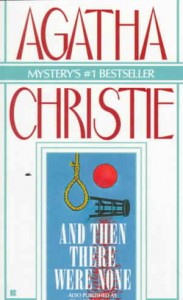

I think I enjoyed this book as much as I did because I remember it as the first time a teacher treated my class like we could handle things like hearing offensive words and understanding complex subjects. She didn't hesitate to tell us that the book was originally called something else that would be very offensive today, and she had us read some of the more difficult passages in class so we could discuss them together. (After all, how many 12-year-olds do you know who would understand the "swan song" reference? In fact, how many full-grown adults do you know who would pick up on it?)

Beyond that, though, I've never been a big reader of mysteries. I didn't do the Nancy Drew thing (or Hardy Boys, either). So this was the first mystery I read and paid attention to, and it was a very good one. For Christmas the year I read this in school, I received a few other Agatha Christie books (because I had announced my love of this one) but I thought they all paled in comparison to And Then There Were None. It's possible that this was because I was twelve, and I didn't have a teacher explaining the more antiquated references, or it could just be because my thirst for mystery had been slaked with just one.

A few years after I had to read this book for class, I thought about it and realized that I didn't remember the ending. I couldn't remember whodunit! So I found a copy somewhere and re-read it, and was surprised all over again. Unfortunately, I remember it now, but it's still not a bad re-read from time to time.

Cassy's Favorite

While I have read more than my fair share of books during my middle and high school years (half of which I don't even remember now, there were so many), Orwell's 1984 always stood out in my mind.

I think one of the reasons I liked it so much in school was because it was one of the first books I read that wasn't bogged down in language I didn't understand or references I didn't get or topics I didn't really find that interesting.  It wasn't Shakespeare, which, let's face it, most of us had no idea WHAT he was saying in high school (and if you tell me you did, you're lying), nor were there chapters fully devoted to turtles (if you've read it, you know exactly what I'm talking about.)

1984's language is pretty plain and the plot is easy to follow.  Besides, it's about someone constantly watching you, constantly having to watch your back.  There's espionage and trickery and a Government that always knows what you're doing.

And the best part?  It's a book that was easy to discuss, even in high school. Question one: do we live in a world like this now?  The constant debate on what our government watches and the rights we have, even in High School was alluring.

I read this again about a year ago and I realized that I still really love it.  It's a great book and, honestly, I still love it for all the reasons that I did before (and the fact that just after finishing it, one of the engineers I worked with made a Room 101 reference and I got it, just made me love it more.  Especially when I told him I had just finished the book and he, sheepishly, responded that he had only ever seen the movie.)

Alex's Least Favorite
Just like with my favorite school reading, it was really hard to choose between two finalists for my least favorite. I think that really, my least favorites would be the ones that had absolutely no impact on me, because that must have been an enormous waste of time. (I remember that we were supposed to read The Great Gatsby but I remember nothing about it.) And while I really hated reading Things Fall Apart by Chinua Achebe, I don't remember why, so I don't think it would be fair to discuss it here. Which leaves me with Animal Farm by George Orwell.


Wait... Don't get me wrong. I actually kind of liked this book. After the fact.

If you aren't familiar with it, Animal Farm uses a barnyard as a political allegory. That means it's all a metaphor. For those of you who weren't so great with your literary terms, think of it this way. "My room is a pig sty" is a metaphor. My room isn't really a pig sty; it's just messy, like you would expect a pig sty to be. Metaphor! And an allegory is like applying that to a whole book. (It's not a perfect definition, but it's close.)

See, Orwell was a democratic socialist. He wrote Animal Farm to critique Stalinism and a lot of other political stuff that I vaguely remember. It is rife with symbolism and personification and imagery and pretty much every single literary device you're supposed to learn in high school English. Which means you have a lot of content to deal with when you read this book in school.

I'm glad I had to read it for school. Otherwise, I may never have picked it up, or if I did, I wouldn't have understood all the symbolism. But the way it was taught to me ruined it for me. I can only describe it as a mountain of busy work. I would have much preferred being able to focus on reading and understanding the book instead of stopping myself every few sentences to write an entry. (Vocabulary word, part of speech, definition, sentence it is found in, write your own creative sentence using it. Dozens of these per section. At least 150 by the time we were done.)

But, perhaps I'm wrong. Perhaps the reason I can enjoy the book today is because I have all that base knowledge somewhere in the back of my head from completing every word of that busy work.

Cassy's Least Favorite


I, like Alex, had a tie for least favorite.  While I have a special hatred in my heard for Wuthering Heights, I developed most of that hatred in college (mostly because I had to read it back to back semesters, and that was the third time in three years I had to pick up that God forsaken book.)  If we're concentrating on High School books, well, The Red Badge of Courage easily takes the award.


Do you know what I remember from this book?  The color yellow = cowardice.  That's it.  Really, NOTHING happened in this book.  The writing in it was terrible.  Usually, I was a kid who read ahead, but the book was so incredibly boring, the imagery so poorly written, I couldn't bring myself to do it.

The other thing that made me really loathe this book?  The endless paperwork that went along with it.  There were questions, upon questions, upon questions.  Worksheets full of them that we had to answer.  I remember filling in an answer with 'he got amnesia' because I just didn't care.  I got zero points on that question.  But you know what?  I got the stupid worksheet done.

Crane really has one of the worst times in American History at his disposal, and he couldn't even make it mildly interesting!  It took weeks to plow through this book.  And do you want to know the absolute worst part about it?

The book is only 112 pages long.  It feels like it's about 400.

*We apologize in advance for the length of this post.  We understand it's a bit cumbersome, but it's fun.  We promise.

Tuesday, December 4, 2012

The Best Book Sites

If you haven't noticed already, Alex and I are pretty crazy about books.  Besides our own super awesome site that you should visit on a daily basis, I'm going to tell you about some super awesome book related sites that you might also like (but that are clearly not nearly as cool as ours is. ;))


I found this site a few months ago and it's exactly what it says it is: eye candy for the book lover.  It has unique, fun and just awe-inspiring bookshelves.  It shows bookshelf furniture, bookshelves in library, and even has a few other links and videos interjected about books along the way.  It's a great site for when you want to drool over books, or just plan your future library.


Goodreads is probably one of the best sites to track and interact.  You can look up every one of your books, keep track of not only what you've read, but what you want to read and where you are in your book.  Your friends can see what you're reading and they can comment.  You can review things, and even enter to win books.  It's a great site with a huge base.


On this site, a few photographers wander around NYC subways and take pictures of people reading books.  It's a fascinating looking into people and their tastes.  Not to mention, demolishing your preconceived ideas of people.  It has everything from dad's reading parenting books to middle school girls reading Pride & Prejudice.  It's fun and inspiring and definitely worth checking out.

Some other sites that I haven't followed, but come on good authority:

Bookshelf Porn actually made it onto the NYTimes best bloggers of 2012 list.  So I decided to take a peek and here are two blogs I found that are right up our alley.


Alex is very graphic novel happy, and I know a few of you are really into it, so this could be a really great blog for you.  They cover everything from DC to Marvel to online comics.  They get into the comic culture and update you on other news in the biz.


While we would never advocate leaving us for another review blog, Omnivoracious offers an insight that a lot of other sites don't.  Run by the editors at Amazon.com, the cover everything from interviews, to the best books and even do things like review cookbooks.  Best of all, they encourage critique through comments, really letting their readers have a voice.

Bonus (slightly) book-related site:


This is a site I came across a number of years ago and, while not specifically book related, entirely useful.  It's a HUGE compilation of the most common errors people make in the written English language.  It's categorized by letter, so it makes what you're looking for incredibly easy to find.  Having trouble with affect/effect?  It covers that.  Constantly make a lot one word?  Covers that too.  It even covers common sayings that people say or use incorrectly (such as mute/moot point.)  Bookmark this site because, I promise, you'll use it more than you ever thought.

Those are just a few of the sites we love here at ReviewMeTwice.  Most of all, we just love books.  Have a book blog or a site that you visit all the time?  Just drop us a comment!  We always love looking at things that have to do with books.

Monday, December 3, 2012

Book Clubs

In celebration of this week's book, The Unbearable Book Club for Unsinkable Girls by Julie Schumacher, we're going to tell you a little bit about book clubs.

In case you don't know what a book club is, it's a group of people who read the books and talk about them. In that sense, Cassy and I are like a two-person book club (of awesome), because we choose a book to read, read it at the same time, and then come together to discuss that book before we start the cycle over again. This makes us a single-title book club, because we read one book at the same time.

One of the most famous single-title book clubs is, of course, Oprah's Book Club, of which I'm sure most of you have read at least one of the books, whether you meant to or not.  Cry, The Beloved Country; Love in the Time of Cholera; A Tale of Two Cities; all of them have ended up on Oprah's book club list. Originally, Oprah's Book Club was a part of her self-titled talk show. She started it in 1996. Each month, she chose a book for her and her viewers to read, and then the book would be discussed. There was often a huge increase in sales of any book selected for Oprah's Book Club (referred to as "the Oprah effect." because Oprah is a media behemoth.) When her talk show ended on May 25, 2011, so did the book club. Not one to disappoint her beloved followers, Oprah revamped the book club and gave it a new home online, creating Oprah's Book Club 2.0, which began this June.


image


Online or broadcast book clubs are popular, because you don't have to get together with a group at a set time (and if you don't tell anyone you're participating, then you don't have to answer to anyone if you don't finish the book.  I, on the other hand, have to answer to Alex.  She's a meanie when she doesn't finish book. ;)). One of my favorites (in theory; I don't follow it as closely as I'd like) is from one of the best library-themed webcomics I know: Unshelved.


Then you have local book clubs, where a group of people get together in person to give their opinions and impressions of the book they read together. These can be held at libraries, bookstores, schools, coffee shops, or one member's house.  

The biggest problem with single-title clubs is that it can sometimes be difficult for everyone to get their hands on a copy of that specific book in time to read it for the designated discussion date. This isn't such a problem if you're willing to buy every book, but that is expensive and impractical. Book choices must be carefully selected, taking into consideration many factors, including availability.

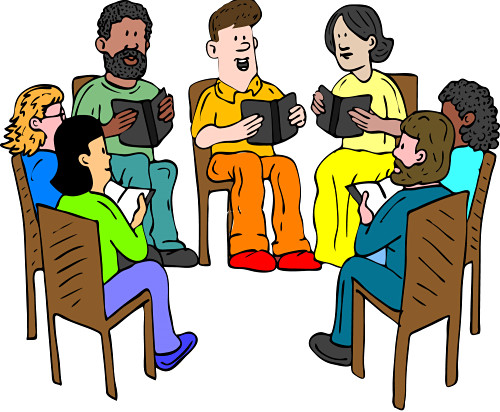
There are also multi-title clubs, which help alleviate the problem of availability. Typically, these clubs work like this: Imagine all the members of the multi-title book club sitting in a circle. Everyone starts with a different book. They all finish reading these books around the same time, and pass the book they just read to their left. This continues until everyone has read all the books. There are other ways to accomplish multi-title book clubs, but this is a fairly common practice.


Beyond the regularly-meeting (in person or online) book clubs, there are one-time book clubs. I recently attended a professional conference where the keynote speaker was an author. One of the sessions at the conference was an author-led book club meeting. The idea was that anyone who wanted to participate could read the book before the conference, and discuss it with others (including the book's author, how cool is that?!? Dude, I would have been all over that.) during that session.

There are lots of different names for book clubs, including book discussion meetings, literature circles, book groups, reading group, common reading programs or common reads.

Book clubs are really great because, as Alex and I discovered when we left college (and part of the reason that we started up this blog), often when you read a book, you're bursting with things to talk about.  Do you think she should have ended up with him?  Why do you think the author put children in a book about mice?  Do you think this could really happen?  By having someone to bounce ideas off of, to talk to about books, they can not only discuss the ideas you had, but open up whole new possibilities that you never even thought of.

Alex and I, though (as you see by reading) we have a lot of the same opinions, we have totally different ideas and backgrounds.  For instance, Graphic Novels are really her thing, but by listening to her, I'm learning how to do things like "read" the illustrations.  Book clubs also help you make connections.  Wrote a book but need someone to read it?  Who better than a brutally honest book club to help you out, people you've known for awhile but trust to be honest and insightful with your work?

Now that you're dying to join a book club, how do you find one?
- Check the bulletin boards (or website) for your local library.
- Do the same at your local bookstores (big chains or mom-and-pop).
- If you're in school, ask at the library (or student activities) if they have one.
- Google! Since Google has gotten smarter, it will likely recommend local book clubs first, but you will also find online book clubs.
- Ask at work. (Don't know who to ask? Try HR.)
- Ask your friends! If none of them already belong to one, maybe they'd like to help you start one yourself. (I'll have tips for running a book club on Thursday.)