Thursday, August 7, 2014

On Didacticism... for Adults

You may recall the last time I addressed didacticism, in the context of children's books. Let's look at didactic stories for adults now, shall we?


I'm talking about this today because Ayn Rand is an excellent example of an author who wrote didactic stories. Warnings against certain aspects of society that, unchecked, would ruin us. Remember: by "excellent example of ... didactic" I mean "beats you over the head with a lesson until it's literally lodged in your brain meat."


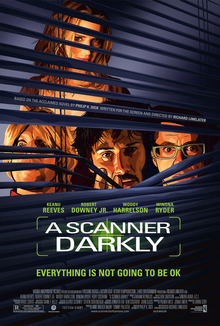
Philip K. Dick is another author whose name pops up all over the place when you're searching for didactic adult books. Something about sci-fi written in the 1960s, it's incredibly didactic, full of explicit warnings about the future.


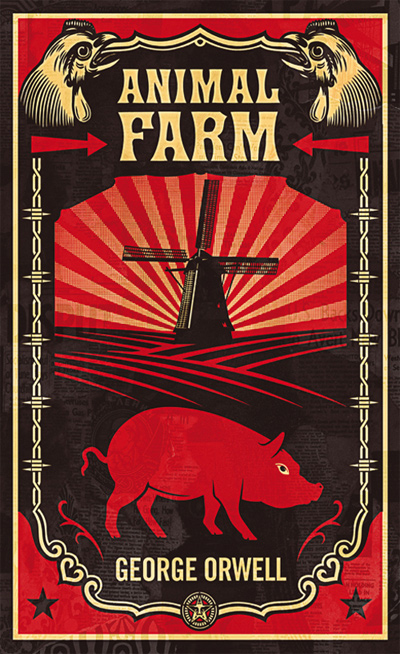
And you can't talk about dystopia and didactic without talking about George Orwell. Personally, I actually think he's one of the lesser offenders, unless you're talking about Animal Farm. Remember how that was my least favorite assigned reading in school? I knew I was being talked down to... for once, it wasn't because I was supposedly young and stupid, but I felt like anyone, teen or adult, reading that book would be talked down to.

When you get right down to it, most stories are didactic on some level, because most stories incorporate a lesson, whether on purpose or not. An example of behavior is shown to the reader, and consequences occur for the character who acted. Even if someone is shown doing something good and not being rewarded, or even being punished for it, you're learning that no good deed goes unpunished, or not to expect rewards for good behavior (perhaps you should be good for the simple reward of being good). But the books listed here make it obvious that they have a lesson to teach you, and you aren't going to get through the book without hearing it... a lot.

What didactic stories for adults have you read? How did you feel about them?

Wednesday, August 6, 2014

Least Favorite Dystopian Novel

We love dystopian novels around here.  LOVE, love, love them.  But, let's face it, not every one can be good, and that applies to dystopian novels as much as any other book.  So this week, we're giving you a least favorite.


Ok, I don't want to give too much away with this because, well, let's face it, it's the third (and sort of final) book in the Divergent series.  There's a lot to give away.

But I hated it.  And not for the reason a lot of other people hated it (which I won't reveal), but there was a particular thing everyone hated, which I actually thought improved the book tenfold.

(Ok, fair warning, this part will be a little spoilery).  

But for the first, oh, I don't know, two thirds of the book... NOTHING HAPPENED.  I mean, absolutely nothing.  They sat and putzed around a complex and talked about what happened in the past and it was about 300 pages of exposition, with this fake rebellion in the middle of the book as if to say, "yes, I know I'm getting boring, so here's the plot of the last two books in 40 pages.)

So, Divergent and Insurgent good, Alligiant super boring and did not live up to its predecessors at ALL!

Guess what I learned about myself? I can't find a single book of dystopian fiction that I genuinely dislike that I've read. Turns out, there's so much of this stuff out there, I just don't read the ones I don't think I'll like. So to avoid cheating you out of half a post, this is the dystopian book I liked the least (though I don't really dislike it)...


I wasn't introduced to The Giver by Lois Lowry until college (despite having a whole shelf full of books by that woman, I had never even heard of this one, somehow) so I don't have a childhood experience with it.

I don't feel emotionally invested in it like I do with Hunger Games or even Divergent, and I don't think I'll see the movie in theaters when it comes out, like I did with the aforementioned.

And I don't think it has to do with the protagonist not being female (though, you've noticed that's the recent trend, right?)... I think it has more to do with his age than with his gender. He's younger than your average dystopian hero.

Now remember... I don't actively dislike this book... it's just the one in the genre that I like the least.

Tuesday, August 5, 2014

I'm Writing A Short Novella Novel

We've ll heard the terms, and we've probably read all three of them, but really, what IS the difference between the three?


Let's start off with the smallest.  Short stories usually only consist of one or two characters, in a very limited setting.  It's very focused on character development because there isn't really anything else to do.  If it gets to long, it's not considered a short story anymore.  Short stories usually sit at less than 10,000 words, and sometimes not even that many.  They tend to be focused entirely on one character and some internal struggle that their having.  Check out Alex and I's favorite short stories post to get some good examples


Novella's are what we are reading this week.  They're longer than short stories, but aren't quite the length of a novel.  Between 15 and 40,000 words is usually where an author should be keeping it.  Also, they tend to take place over very short periods of time, a day or a week.  This week, Anthem by Ayn Rand is considered a novella, so if you check back in on Friday, you'll see our review.


A novel is usually 50,000 words (as we all know from Alex and I's frequent interactions with NaNoWriMo.)  It can take place over the course of one day (Ulysses) or many, many years (Rhapsody).  There are usually an entire cast of characters, and there's also no limit to the amount of words that you can have.  It's not like there's anything past a novel.  If you hit over 100,000 words you're just writing a very LONG novel.

Monday, August 4, 2014

Author Bio: Ayn Rand


That's right, we're reading a book by Ayn Rand this week! Don't worry... it's not The Fountainhead (1943) or Atlas Shrugged (1957). In fact, I hadn't heard of this week's book, Anthem, until a friend recommended it to me as a good introduction to Ayn Rand's work.

Ayn Rand lived from 1905 to 1982; she lived in Russia until she moved to the United States in 1926. She is best known for the two ginormous novels I mentioned above, as well as developing the philosophy known as Objectivism.

At its most basic, Objectivism has a few central tenets: reality exists independently from consciousness, people have direct contact with reality through their senses, people can obtain objective knowledge via perception using concept formation and inductive logic, the moral purpose of your life is the pursuit of your own happiness, the only social system that matches this concept is laissez-faire capitalism, and art's role in human life is transforming humans' metaphysical ideas via selective reproduction of reality into physical forms that nobody comprehends and people can respond to emotionally. Yeah... I did say that was "at its most basic."

As you can probably guess, Rand wrote a lot of essays about these concepts and more, in addition to her body of fictional works.

For more on the woman and her work, check out aynrand.org.

Friday, August 1, 2014

Review Me Twice - Boy Meets Boy by David Levithan


Did you ever read a book that, no matter how many times you read it, it just makes you feel... good?  That's how I feel about Boy Meets Boy.  First, I love the world Levithan creates.  It's one in which, almost everyone is tolorent, and those that are not, are actually frowned upon (I won't say looked down on, because you don't get that vibe, but you definitely get the WE DO NOT APPROVE vibe.)

The star quarterback of the football team is also the homecoming queen.  Paul, our main character, has know he was gay since he was in kindergarten and his parents are completely cool with it.  As is everyone in his school.  The drama that's created is usual high school drama, but without any of the prejudices.

I love that it's just a story of love.  It's a story of getting to know a person, learning to trust them, learning to let yourself love.  And not just romantic love.  It's learning to love like a friend, like a family member, like a decent human being.  It's a group of high school kids all just... learning what high school is like.

Really, I think this is the most wonderful, most heartfelt and most feel good book you could ever read.  And you should.

I didn't say it very explicitly when we reviewed The Fault In Our Stars, but the overwhelming "quirkiness" of the characters is part of why I really didn't like them. By that standard, I should also dislike the cast of Boy Meets Boy, but I don't... they're lovably quirky. I suppose that's probably a matter of opinion more than anything else, but that's how I see them.

It's so great to see a healthy relationship in a YA novel, and on top of that, I'm thinking specifically of titular gay relationship. Most of the characters are good role models for any young adult (I say "most" because nobody's perfect) and it's awesome to see them acting like real people. (Maybe that's why I forgive their forced quirkiness... they still act like real people despite it.)

Thursday, July 31, 2014

Sex Scenes for Teens

When I first read this week's review book, Boy Meets Boy by David Levithan, several years ago, I realized something about it... it contained the first gay sex scene I had ever read. (Granted, I had only read a handful of sex scenes in the first place, most of them from the Earth's Children series by Jean M. Auel.) So I wanted to address sex in teen books this week, because that's what I think of when I think of this book.

---

You know what's awkward for teens? Talking about sex. (Okay, that can be awkward for any age group.) You know what's a little less awkward? Reading about sex.


Think about it... you're a teenager, figuring out the whole "sex thing" from your equally clueless friends, euphemistic media examples, your parents' stuttering and mumbling about how you should practice safe sex, and weirdly omissive sex ed classes that mumble about how you shouldn't have sex at all. How are you supposed to sort out what really happens after the camera pans away and you hear bedsprings squeaking in whatever R-rated movie you happened to sneak into? (And don't tell me that porn will explain it to you... maybe some of the mechanics, but I hope you know better than to believe that most porn is a realistic depiction of a healthy sex life.)


Even worse, try being an LGBT teen. Sure, in recent years, it has been easier to find sex ed classes or counselors or even just friends who know more about sex between two men or two women or what kind of surgery transsexuals undergo, or any of the billion questions spilling out of that can of worms. But I probably don't have to tell you that it's dangerous in some places to come out, and asking questions about those things will out you if you aren't already out. Even in places where it's more accepted, it can be scary or embarrassing or just something you don't feel like everyone around you needs to know about. There are as many different experiences with this as there are people.

So where's a confused teen to turn? As is often the answer... well-written YA fiction. I'm not saying a novel should be a stand-in for good sex ed classes or mortifying heart-to-hearts with parents. I'm just saying, it's not really your mom's place to give you pointers on what to do with your hands when you're caught up in the moment, and it would be pretty awkward (borderline illegal, probably) for your health teacher to demonstrate interesting positions you might enjoy. (Side note: John Cleese is totally an exception. Totally NSFW; not for polite company.)

The neat thing about a lot of popular YA books is that teens really identify with them. They see bits and pieces of themselves and their friends and their families in the characters, and bits and pieces of their lives in the events of the books. So when they're reading about a character having a first sexual experience, or a fiftieth, or a new type thereof, they know they aren't alone. They aren't the only ones in the world who think they don't know what they're doing, or want something they think they shouldn't, or whatever their hangup is, even though it seems for all the world that they're alone, because nobody talks about these things.


It can be difficult to write sex scenes for adults, but for the most part, adults tend to know what to do and what they like and what they're willing to explore when it comes to sex. Teens are totally new to the topic and are just starting to consider options and learn about themselves in relation to others in this way. Which is why sex scenes for teens have to be so incredibly well-written. (It also helps to find a balance of detail to help the reader and discretion to keep it from being banned for being pornography, but if John Green's Looking for Alaska can be banned for the same reason because of a passage that includes "We didn't have sex. We never got naked." you probably don't have much of a shot at not getting banned if your characters are doing the deed.

So, teens looking for good sex scenes that will talk you through some anecdotal examples, try these out:

Before I Die by Jenny Downham (A terminally ill girl has a bucket list, at the top of which is to have sex.)

Boy Meets Boy by David Levithan - this week's review book! (A totally inexperienced gay boy sleeps with his boyfriend, who is considerably more experienced.)

Bringing Up the Bones by Lara Zeises (After her boyfriend dies, the protagonist sleeps with a stranger.)

The Difference Between You and Me by Madeleine George (A totally-out lesbian and a closeted one meet in secret every week to make out.)

Doing It by Melvin Burgess (A boy desperately wants to lose his virginity.)

The Fault in Our Stars by John Green (Not a huge fan of his main characters, but the sex scene... not bad. Really honest and, I don't know... normal. No stars-in-your-eyes stuff.)

Speak by Laurie Halse Anderson (Sorry to be a downer, but not all sex is consensual. The rape scene in this book is gut-wrenching enough to elicit the right emotional response, but not so much so that it's gratuitous. Having examples of rape is important in YA too, because non-experienced people might not even realize that what is happening to them is rape if they don't have solid, realistic examples to learn from.)

Twilight by Stephanie Meyer - No, seriously. (Really, I mean it. When Bella and Edward finally get down to business, it's not the worst sex scene I've ever read. Honestly. Just give it a shot. Really.)

So let the teens read sex scenes. You can't get an STD or get pregnant from a book, and it's one hell of a lot safer than letting them learn about sex by taking them to see 50 Shades of Grey in theaters.

What's your favorite book with a sex scene for teens? Let us know your recommendations!

Tuesday, July 29, 2014

If I Stay Meet and Greet

So, I'm late on posting today, and it's a busy week anyway, so I'm posting a picture of what I did today!!


That is Gayle Foreman, author of If I Stay (which we reviewed almost two years ago, because we're hipsters like that.), and the lead actress of the movie, Chloe Grace Moretz.  I got stuff signed by both of them!!

Sooooo, stick around for the movie coming out on August 22.  We just MIGHT be giving something special away. ;)